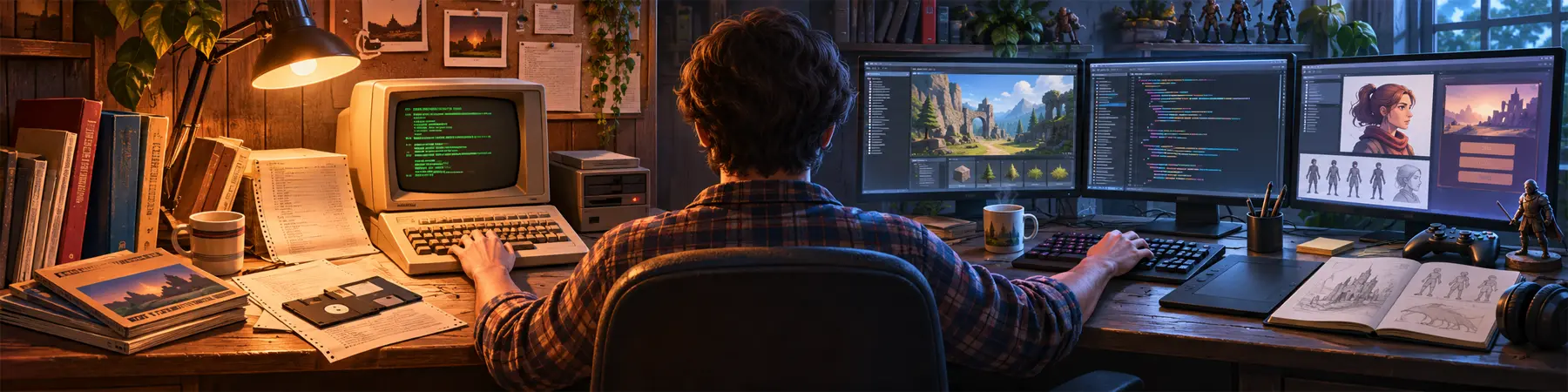
After decades as an artist, programmer, and game designer, I've found that AI helps me learn new skills, run my one-person creative business, and bring more of my ideas to life.
Why I've Chosen to Embrace AI
I've been creating things for most of my life. I started programming when I was 13, worked as a commercial artist long before generative AI existed, and have spent decades working with computers, multimedia, writing, and game design.
Over the years, I've accumulated quite a collection of ideas. Games I want to develop, software I want to build, stories I want to tell, and artwork I want to create. Some of those ideas have been waiting for decades.
I've always had more ideas than time to pursue them.
So when AI tools started becoming genuinely useful, I was curious about what they could help me accomplish. I'd already spent a lifetime developing creative and technical skills. Here was a new technology that might help me put those skills to work on more of my projects.
And that's exactly what I've been doing.
Running a One-Person Creative Business
For the most part, I'm a one-man band.
I'm the artist, programmer, writer, game designer, web developer, video producer, researcher, and marketing department for my creative business. Sometimes I'm several of those things in the same afternoon.
I enjoy that kind of independence. I can come up with an idea, develop it, and bring it to market without coordinating an entire production team.
But there's a downside. Every hour I spend working on one thing is an hour I'm not spending on something else.
AI has become particularly useful for all the work that surrounds my creative projects.
I use it for market research, learning about my audience, and figuring out how to improve the search engine optimization of my websites and YouTube channel. It helps me research topics, identify opportunities, develop content plans, and organize the many tasks involved in running a small publishing business.
It's also become part of my writing workflow. I can use it to review an article, proofread a video script, or suggest improvements to a product description. When you've already read something twenty times, having another set of eyes on it can be surprisingly helpful.
Since I started integrating AI into my workflows, my creative business has been doing better than ever. I can't attribute every improvement to AI, but it has certainly helped me accomplish more with the time and resources I have.
From Library Books to an Interactive Teacher
One of my favorite things about AI is how useful it has become for learning.
When I was 13, I started teaching myself to program computers. Growing up in Santa Fe, New Mexico, I checked out programming books from the libraries and typed BASIC programs from computer magazines into my computer.
If something didn't work, I had to figure out why. Sometimes it was a typo. Sometimes I misunderstood the instructions. And sometimes there was actually something wrong with the program I'd copied.
I spent a lot of time comparing code to printed listings, reading technical references, and experimenting until I understood what was happening.
Later, I taught myself C from Kernighan and Ritchie's The C Programming Language. I'd been programming for nine years before I took my first formal programming courses.


I've never really stopped teaching myself new things.
These days, AI is one of the tools I use to do that. It's helped me learn Python and Flask, understand how to connect Joomla website interfaces to API backends, and figure out best practices for various programs and development environments.
Instead of searching through dozens of tutorials hoping to find one that addresses my particular problem, I can explain what I'm trying to accomplish and ask questions as I work through it.
If I don't understand an answer, I can ask for another explanation. If something doesn't work, I can provide the error and investigate further.
It's a bit like having an interactive technical manual that can discuss the problem with me.
Not a perfect manual, mind you. AI can misunderstand a question, invent functions, or recommend outdated techniques. I still check documentation and test what I'm learning.
But the difference in how quickly I can explore unfamiliar technologies has been remarkable.
I still enjoy figuring out how things work. AI just helps me spend less time searching for answers and more time putting them to use.
Programming Without All the Repetitive Work
I've always enjoyed programming. There's something satisfying about taking an idea, designing a system, and watching it come to life.
But not every programming task is particularly interesting.
Suppose I'm building a web application with dozens of buttons, form controls, settings, and validation routines. Once I've worked out how everything should function, much of the remaining code can become repetitive.
That's a great opportunity to use AI.
I can establish the requirements and interface design, then use AI to help produce the repetitive code. After reviewing and testing it, I can concentrate on the more interesting problems.
I've also used it to troubleshoot errors, review existing programs, understand unfamiliar libraries, and explore different approaches to a technical problem.
Over my career, I've watched programming tools evolve from BASIC interpreters to compilers, integrated development environments, modern frameworks, and game engines.
Each generation has made certain tasks easier.
AI feels like another step in that evolution.
I learned to program the hard way. That doesn't mean I need to keep doing everything the hard way.
Creating Art for Cosmic Drifter
One of the challenges of developing a game by yourself is just how much artwork you need.
I'm developing Cosmic Drifter, a story-driven science-fiction roleplaying game. It needs characters, portraits, items, equipment, locations, interface graphics, and countless little details that help make the world feel believable.
Even with artistic experience, creating all those assets can consume an enormous amount of time.
AI gives me another way to tackle that workload.
I can establish a visual direction, develop character concepts, generate variations, and create supporting artwork that fits the game's setting. I can also refine individual assets to make them more consistent with the rest of the game.
That last part is important. AI doesn't automatically produce consistent artwork. Sometimes it takes several attempts to get something usable, and sometimes I have to correct or rebuild parts of the result using other tools.
But it lets me explore far more possibilities and produce supporting material much faster than I could by creating every asset entirely from scratch.
And for a solo game developer, that makes a tremendous difference.
Bringing My Traveller Setting to Life
I've also been experimenting with AI-generated video to create short scenes from my Traveller RPG setting.
As a Game Master and science-fiction creator, I've spent decades imagining starships, alien worlds, characters, and adventures. Much of that material has existed as written descriptions, maps, illustrations, and stories shared around the gaming table.
Now I can experiment with turning some of those ideas into moving images.
A location that once existed only in a paragraph of text or a piece of concept art can become a short cinematic scene.
That's exciting to me because I'm not starting with an empty prompt and asking AI to invent a universe. I'm starting with a setting I've already developed and exploring new ways to show it to people.
I use a similar approach with some of my traditional art. I might begin with a sketch or a rough 3D framework, then use AI to explore lighting, materials, details, or different ways to develop the composition.
Some experiments become useful assets. Others simply give me ideas to pursue with my regular tools.
Either way, it's another opportunity to bring something from my imagination a little closer to reality.
Finally Getting to Some of Those Old Ideas
I've been designing games for decades, and my backlog shows it.
Some ideas are relatively small. Others would take years of work to complete on my own.
When I was around 16 or 18, for example, I came up with an idea for a game about Santa Claus delivering presents down chimneys. I've carried that idea around ever since.
Then there's The Crucible, a game I developed using Manticore Core.
I designed and programmed a playable version of The Crucible before today's conversational AI assistants became widely available. I built systems for dungeons, monsters, interactions, and discoverable lore.
But building a game's systems is only part of the job.
Those systems need content. Dungeons need encounters. Monsters need abilities and descriptions. Books scattered around the world need interesting lore for players to discover.
That's where AI can help me expand on something I've already built.
It can assist with brainstorming encounters, developing variations, drafting supporting lore, and organizing structured information for the systems I've designed.
I still have to choose what works, make the pieces fit together, and turn the material into a good experience for players.
And the same applies to plenty of other ideas in my backlog.
Not every project will get finished, and AI certainly doesn't remove the work involved. But projects that once seemed unrealistic for a one-person operation are starting to feel more achievable.
A Sounding Board That Doesn't Get Tired of My Ideas
One of my more frequent uses for AI doesn't necessarily involve producing anything at all.
Sometimes I just want to talk through an idea.
When you're working alone, it can be helpful to have a sounding board. I can describe a game mechanic, outline a story, or explain a problem I'm trying to solve.
Then I can ask for alternatives, potential problems, or suggestions I might not have considered.
Sometimes the responses are useful. Sometimes they're completely wrong.
But even a bad suggestion can be valuable if explaining why I disagree helps me clarify what I really want to do.
I also use AI as a production assistant. It can help me organize a backlog, break a complicated project into manageable steps, or figure out what I should work on next.
That's especially helpful when I'm juggling game development, publishing, video production, and website maintenance.
It doesn't make decisions for me, but it helps me think through them.
I Still Want to Do the Fun Part
With all these advantages, there's one thing I don't want AI to take away from me.
The fun of creating.
I enjoy designing game systems, writing software, making artwork, developing characters, telling stories, and solving interesting problems.
I don't want to type a prompt and come back to discover that a machine has made an entire game for me.
I want to experiment. I want to make decisions. I want to understand how things work and experience the satisfaction of building something.
Of course, that doesn't mean I need to do every tedious task myself.
There's a big difference between designing a game mechanic and manually entering hundreds of similar records into a database. Both might be necessary, but only one is likely to be the part I'm excited about.
That's the balance I'm looking for.
I also believe in being transparent about the role AI plays in my projects. Sometimes I use it for research, editing, or programming assistance. Sometimes I incorporate AI-generated assets into something I'm creating. Some of my Game Master tools include AI-powered features, while others are conventional software.
Those are different uses of the technology, and I'm comfortable explaining what AI contributes.
I know there are legitimate concerns about AI, including how models are trained, how creative work is attributed, and what the technology means for working artists.
I take those concerns seriously. But I also know what AI has made possible in my own work.
More Time to Make the Things I Love
After all these years, I still have an enormous list of things I want to create.
Games I want to finish. Worlds I want to develop. Videos I want to produce. Software I want to build. Artwork I want to make.
AI hasn't changed that. What it's changed is how much of that work I can realistically take on.
It's helping me learn new technologies, improve my business, develop supporting assets, and get through some of the repetitive tasks that used to consume so much of my time.
For someone who works mostly alone, those advantages add up.
I'm getting more done, experimenting with more ideas, and making progress on projects that might otherwise have stayed on the drawing board.
And I'm still enjoying the process.
I've spent decades learning to be an artist, programmer, writer, and game designer. AI didn't give me those skills.
It gives me new ways to use them.
AI didn't make me a creator. It's helping me create more of what I've always wanted to make.
Explore My Work
If you'd like to know more about my background in art, programming, multimedia, and game development, you can read about my creative journey.
You can also visit CyborgPrime Games to explore some of the games, tools, and projects I've been developing.
Thanks for reading.
Frank Succardi
CyborgPrime Games